OneCasino Licence and the NZ Legal Position
 Available in US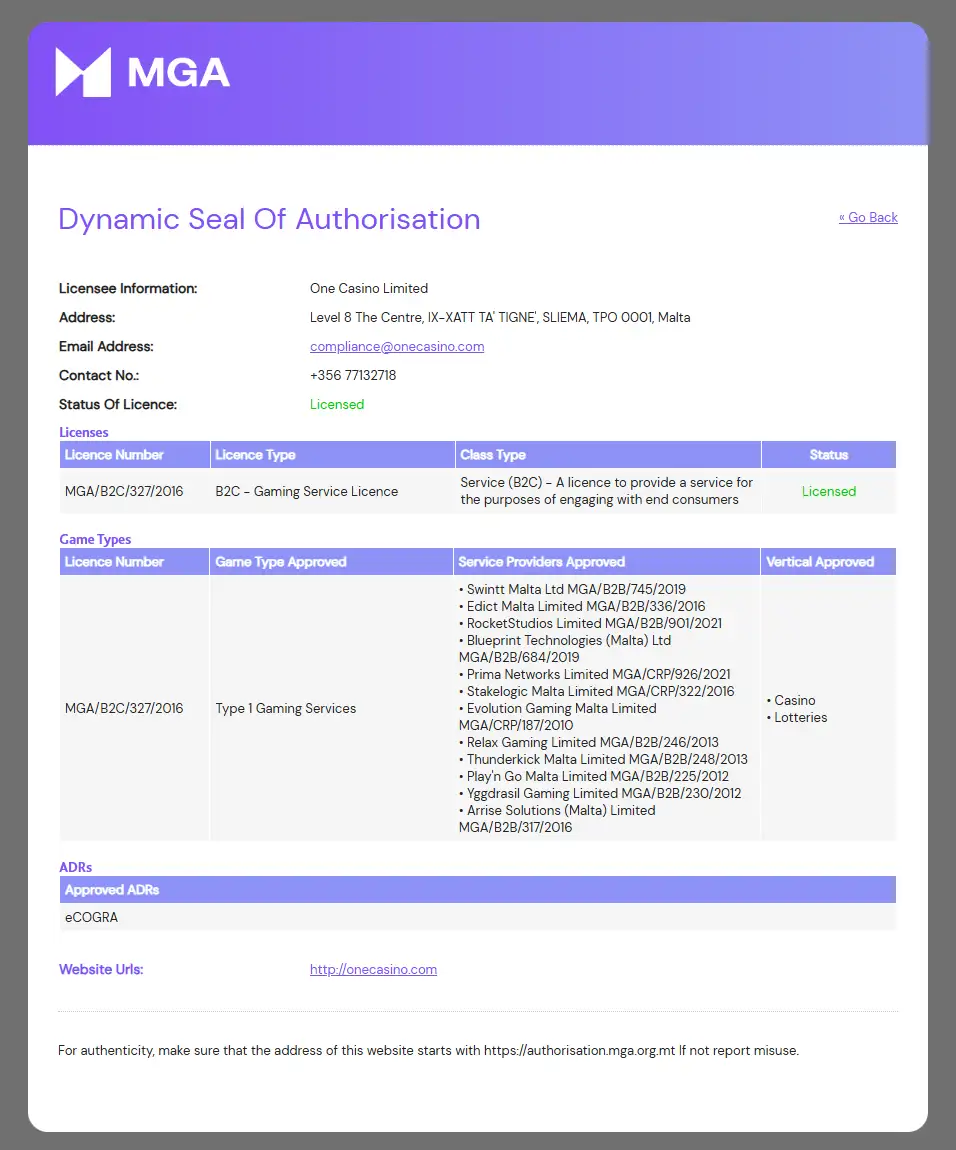
Contents
New Zealand regulates online casinos under a phased 2026 transition. OneCasino has a Malta gaming authorisation covering its official domain, but it does not have an issued New Zealand online casino licence. Whether an operator meets transitional conditions and whether a person can currently hold an account are distinct questions.
OneCasino and New Zealand’s licensing transition
New Zealand’s Online Casino Gambling Act 2026 took effect on 1 May 2026. It creates a controlled transition, followed by a licensing market. From 1 May to 1 December 2026, an online casino provider may rely on the transitional arrangements only if it was already providing online casino gambling to people in New Zealand before 1 May. This conditional permission is not an issued domestic casino licence and it does not open the market to every international website.
OneCasino has historical customer activity associated with New Zealand, including accounts from NZ-based customers describing deposits and withdrawals before the May commencement. Such experiences are relevant to the question of pre-existing operations, but they do not determine every legal condition for transitional eligibility. OneCasino does not hold an issued New Zealand online casino licence at this stage: the Department of Internal Affairs (DIA) anticipates the first licences in early 2027.
From 1 December 2026, the transitional mechanism changes. Continued activity will be tied to a successful licence-auction bidder whose licence application is under consideration. Historic operations alone will no longer provide the same basis. The existence of a Malta authorisation cannot substitute for the New Zealand process, and there is no basis for treating OneCasino as a successful NZ bidder or an approved future licensee.
Eligibility to open an account is a separate practical question. OneCasino’s terms prohibit registration and use from countries absent from its country-selection list. Historical NZ customer accounts do not establish what a new user would see in the current interactive registration form. For legal information, consult the DIA guidance for players instead of assuming that a working website means licensed availability.
| Period | New Zealand framework | Practical meaning |
|---|---|---|
| From 1 May 2026 | Conditional transition for pre-existing casino providers | Prior customer activity alone does not grant a licence. |
| From 1 December 2026 | Exemption tied to qualifying auction outcome and licence application | Earlier activity does not by itself authorise continued provision. |
| Early 2027 expected | First NZ licences anticipated | OneCasino does not currently hold an issued NZ online casino licence. |
How gambling winnings and duties are treated for tax
New Zealand tax treatment depends on what the money represents and the taxpayer’s circumstances. Inland Revenue’s general prize-money guidance says prizes are ordinarily outside taxable income when they are not earned as part of a taxable activity. That principle does not exempt every gambling-related receipt in every situation; regular profit-seeking or business activity can call for a different analysis. A bank credit labelled as a casino payout is not, on its own, a complete tax classification.
For an individual, relevant distinctions include the nature of the activity, whether participation forms part of a business, and whether related income is otherwise taxable. Record the deposit, any withdrawal, the date and value of a currency conversion, and the financial account involved. Currency movement can alter NZD amounts even when the underlying win or loss is expressed in euros. Records are useful for personal accounting, dispute resolution and professional advice without implying that every withdrawal creates a tax bill.
New Zealand also imposes a 12% offshore online gambling duty on qualifying operators. That is an operator-side duty and must not be taken as a 12% tax deducted from the player’s winnings. It addresses a different tax base and a different taxpayer. The duty does not establish that an offshore brand has a local online casino licence.
The IRD’s online gambling duty guidance covers the operator levy, while its prize-money information provides broader individual-income context. For a personal gambling-tax position, especially where activity is frequent or linked to professional work, speak with a qualified New Zealand tax adviser. Treat the final NZD amount received and the legal character of the income as separate questions.
What player protection changes with a local licence
Domestic regulation determines which rules a provider must follow and which New Zealand bodies can directly enforce those rules. The 2026 Act introduces a local online casino licensing framework; it does not automatically attach the planned protections for licensed operators to every existing offshore account. OneCasino’s international authorisation and its historic payment activity therefore need to be kept separate from claims about rights under a future New Zealand licence.
If a payment has been disputed, the distinction affects where the complaint can travel. An account holder can contact OneCasino and preserve a clear documentary account of what happened. The statutory escalation mechanism intended for licensed NZ providers belongs to the new domestic framework, whose licences are due to start being issued in early 2027. This does not remove ordinary banking or consumer remedies where they independently apply, but the availability and scope of those remedies depend on the individual facts.
- Account conditions: one account per person; inaccurate identity or payment details can result in restrictions.
- Gambling controls: deposit, loss, wagering and session-time limits, together with self-exclusion, appear in the operator’s policies.
- Payments: the operator’s rules allow identity checks and additional evidence, particularly around transfers.
- Disputes: payment reference numbers, correspondence and terms applying to the disputed event are more useful than an undated screenshot of a lobby.
For related administrative rules, see account verification and limits. Payment problems may need the separate sequence described under withdrawal routing and review. Neither explanation implies that a new NZ registration is presently permitted.
The Malta register names the company and website
The Malta Gaming Authority’s authorisation entry names One Casino Limited and gives the B2C Type 1 gaming-services licence MGA/B2C/327/2016. Its website list includes onecasino.com. The listed Type 1 casino activity and matching domain matter because a regulator record for an associated company or unrelated address would not identify the exact service in question.
The same operator is identified in OneCasino’s international terms as One Casino Limited, company number C 73399, with a registered address at Level 8 The Centre, Ix-Xatt ta’ Tigné, Sliema TPO 0001, Malta. The authority’s record describes a Maltese authorisation. It is evidence of a regulatory relationship in Malta, with its own licence scope and conditions, not proof of authorisation by New Zealand’s Department of Internal Affairs.
The record names eCOGRA as an alternative dispute resolution service in connection with that Maltese licence. Any specific complaint still needs to fit the service’s acceptance criteria and the relevant contractual or regulatory process. The ADR process has eligibility and procedural conditions; any decision depends on the facts of the complaint, while a separate jurisdiction retains its own consumer rules.
| Register field | Entry |
|---|---|
| Authorised entity | One Casino Limited |
| Licence reference | MGA/B2C/327/2016 |
| Casino activity | Type 1 gaming services |
| Listed domain | onecasino.com |
| Alternative dispute resolution | eCOGRA |
The MGA authorisation entry provides the regulator’s record for the operator. The legally important boundary is between a licence for the international website under Malta’s framework and the different domestic approval process now under way in New Zealand.
The New Zealand timetable also limits advertising
The Department of Internal Affairs administers the New Zealand transition under the Online Casino Gambling Act 2026. The country is moving from a transitional framework towards a limited number of domestically licensed online casino providers. The legal starting date, the change in December and the anticipated early-2027 licence rollout serve different purposes: they mark different conditions for operators, not dates on which every international platform becomes locally authorised.
New Zealand currently prohibits online casino advertising during this transition. The DIA says restrictions extend to forms of third-party advertising, including activity involving content creators. Advertising permissions must therefore not be inferred from a casino’s historical presence or from the existence of a payment channel. The future licensing model is also accompanied by restrictions on affiliate-arrangement advertising, endorsements and selected inducements.
New Zealand’s transitional operating rules and advertising restrictions are administered by the DIA under the 2026 framework. Claims made by a marketing intermediary or another casino’s jurisdictional website cannot confer local regulatory standing on OneCasino.
- Identify the legal period. An arrangement available before 1 December does not by itself answer conditions after that date.
- Identify the operator. Distinguish One Casino Limited and onecasino.com from similarly named companies or other-country campaign domains.
- Identify the authority. The MGA record and the NZ DIA framework answer different licensing questions.
The MGA authorisation covers One Casino Limited and onecasino.com. New Zealand has not yet issued its initial online casino licences, and conditional transitional rules do not amount to a standing licence for future operations.
A payment or account complaint needs an evidence trail
OneCasino directs customer-service matters through its help and contact facilities. For a financial dispute, separate the request made, any identity checks, the operator’s release decision and the bank’s later settlement. A request shown as pending at the casino is a different event from funds credited at a receiving institution. Keeping the events in order reduces confusion about which organisation handled the disputed step.
- Record the account context. Preserve the account identifier, country selected, transaction dates, currency and relevant terms that applied at the time.
- Preserve the transaction trail. Keep card or bank reference numbers, amount debited, casino balance movement, payout request details and any receiving-bank record.
- Write a specific complaint. State what went wrong, when the operator was informed and what correction or clarification is requested, without sending passwords or unnecessary sensitive documents to third parties.
- Distinguish escalation channels. The operator’s support route and any relevant eCOGRA procedure relate to the existing terms; New Zealand’s planned licensed-operator escalation belongs to a distinct future licensing framework.
NZ-based customer experiences on OneCasino’s matched review profile include both accounts of successful bank transfers and disagreements over documentation and closure. The company publicly responded to a disputed verification case with information about case review. These are useful illustrations of the type of evidence a payment issue can involve, not independent findings that every withdrawal follows the same course.
Account limits and identity evidence overlap with money movements. The account guide explains why an affordability or identification request can affect access, while the withdrawal guide explains original-method preference and bank settlement. For immediate personal gambling harm or loss of control, free confidential help is available from New Zealand’s Gambling Helpline at 0800 654 655.
Questions about New Zealand rules
Does OneCasino hold a New Zealand online casino licence?
No. The DIA expects New Zealand’s first online casino licences to be issued in early 2027. The current transition is conditional and does not constitute an issued NZ licence for OneCasino.
Is OneCasino’s Malta licence connected to its official website?
Yes. The Malta Gaming Authority record identifies One Casino Limited, licence MGA/B2C/327/2016, and lists onecasino.com among its websites.
Does previous NZ customer activity guarantee current registration access?
No. OneCasino’s terms restrict use by account-country selection, and historical customer activity does not determine an individual account’s present eligibility.
Is the 12% offshore online gambling duty deducted from a player’s winnings?
No. The 12% duty is imposed on qualifying offshore online gambling operators. Individual prize-income taxation is a separate matter that depends on circumstances.
Which body handles a complaint about a OneCasino payout?
Begin with the operator’s customer-service process and keep the transaction record. The MGA licence names eCOGRA as ADR, subject to its applicable process; NZ statutory remedies for future licensed operators belong to a different framework.
What the licence distinction means in practice
OneCasino’s Malta record provides a named company, casino authorisation and exact website match. New Zealand’s 2026 regime, however, imposes its own conditions on operators serving the country. A conditional allowance for historical operations is not the same thing as a licence issued through the NZ process, and neither older customer accounts nor a working casino website proves eligibility for a particular new registration.
The immediate consumer consequences are procedural: know which legal framework governs an issue, keep identity and payment records, use the operator’s complaint facilities for specific disputes and do not assume that the protections being designed for NZ licensees already apply. Gambling still involves the risk of losing money, irrespective of the regulator named on an authorisation record.
This material was created by the OneCasino Notes team.
Related posts

OneCasino Withdrawals and Payment Checks
OneCasino Payment Methods and Currency Handling