OneCasino Games: Slots, Live Tables and Software
 Available in US
Contents
OneCasino combines third-party slot studios and live-dealer games with a set of in-house exclusives, including The Big 5, Mystery and Book of the Gods. The difference between slots, blackjack tables, jackpots and scratch cards changes how wagers accumulate. Game rules, not lobby artwork or a broad RTP claim, determine the mathematical experience of an individual title.
Session pacing creates different kinds of exposure
OneCasino’s library combines video slots, classic slots, exclusive slot titles, jackpots, live casino tables and scratch-card games. Those labels describe different ways of placing wagers, not a single shared risk level. A video slot typically permits repeated spins in a compact sequence, while a live-dealer table follows a round-based rhythm. The amount selected per round, the time spent playing and the frequency of decisions all affect how quickly money can be committed.
For slots, the distinction between an individual spin and the whole session is especially important. A stake is the cost of a particular outcome. Repeated spins can make cumulative stakes substantially larger than the initial balance: a returned portion of earlier wagers may be wagered again. A bank statement shows funds sent to the account, whereas game history can show considerably more total wagering because the same balance circulates. That difference does not imply a comparable amount of fresh money was deposited.
Live blackjack brings another kind of control problem. A table may appear slower than a slot reel, but extra time between decisions is no guarantee of a low financial commitment. Bet size, optional decisions and longer exposure can still increase losses. Scratch cards have their own discrete rounds; jackpots can draw attention toward rare high outcomes without changing the need to understand ordinary losing rounds.
- Slots and exclusive slots: watch the total number of wagers and the amount risked on each spin, not just isolated wins.
- Live tables: separate the amount at risk per round from the duration of a seated session.
- Scratch cards: read each game’s price and prize mechanics rather than carrying assumptions over from slots.
- Jackpot titles: treat exceptional prizes as part of a variable distribution, not an expected result.
OneCasino describes account-level deposit, wager, loss and session-time limits. They are useful restraints to understand alongside the account control settings, although any wagered money can still be lost and a preset limit does not make a gambling session profitable.
Reading RTP without treating it as a forecast
Return to player (RTP) is a long-run mathematical property of a game design. It summarises the share of total stakes expected to return to players over a very large number of comparable plays. OneCasino says that most of its games have an RTP above 96%. That is a broad statement about its catalogue, not the specification of every named title and not a predicted result for a particular account.
An RTP figure needs to be matched to an actual game’s rules and version. A table game can have different theoretical returns under different choices, and slot variations can use distinct payout structures. The general catalogue statement should never be attached automatically to The Big 5, Mystery, Book of the Gods or an Evolution table. Readers who want to understand a particular game need its own rules, stake limits and payout information rather than an average copied from the lobby description.
The mathematical complement of RTP is the theoretical house edge. For explanation only, a hypothetical game with RTP of exactly 96% has a theoretical edge of 4% of amounts wagered across an extensive population of comparable plays. That arithmetic does not imply a player loses exactly four currency units after a hundred units of betting: an actual short run can be much better or worse. A single payout, even a large one, says little about whether the game’s theoretical percentage describes a personal session.
- Locate the rules for the particular game or table rather than the overall casino description.
- Identify whether the stated RTP assumes a particular mode, pay table or strategy.
- Consider the total amount repeatedly wagered, not simply the money first transferred into the balance.
- Keep the long-run percentage separate from short-run volatility and the possibility of losing the entire session allocation.
RTP is therefore an explanation of theoretical distribution over repeated play. It is not a timetable for wins, a guarantee of recovery after losses, or a reliable device for judging how much to wager next.
What the named software suppliers contribute
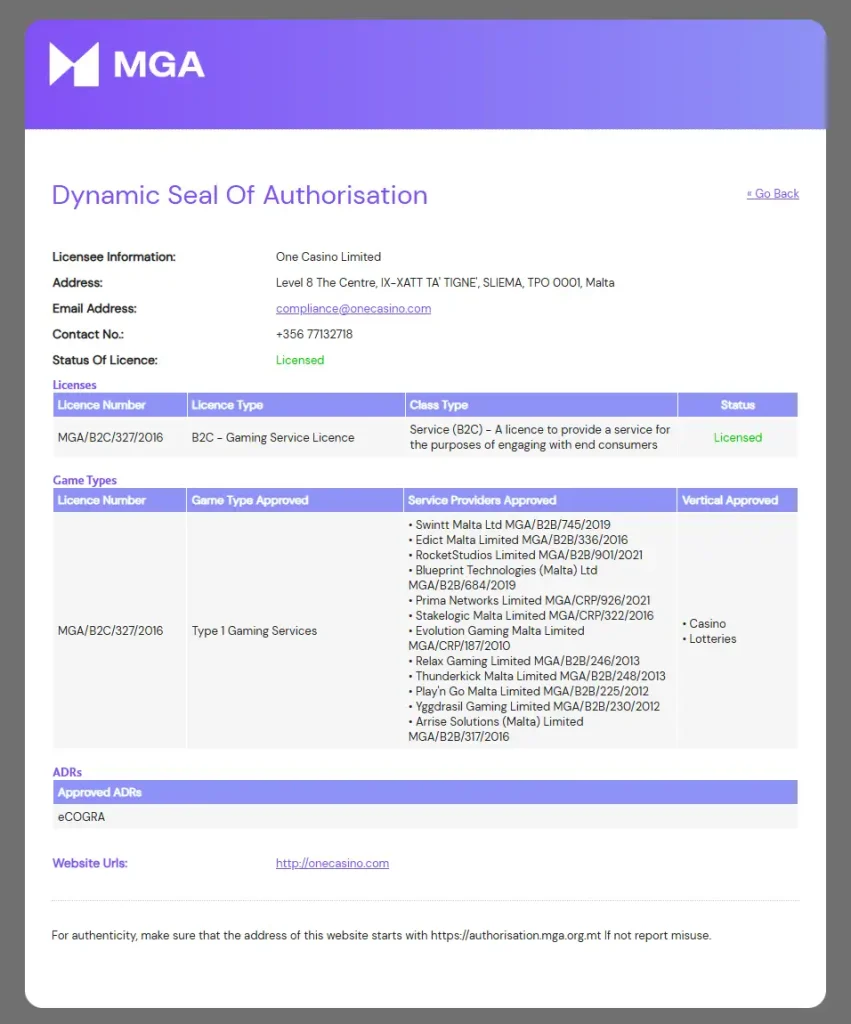
OneCasino’s international game catalogue contains titles or live content from Play’n GO, Evolution, Pragmatic Play, Yggdrasil, Games Global, Relax Gaming, Thunderkick and Stakelogic. The supplier mix helps explain why a single casino lobby can contain different reel styles, feature structures and presentation formats. It also means the mechanics of an individual title cannot be inferred merely from OneCasino’s own account and payment conditions.
Identifying the supplier is a useful starting point for understanding the game’s information panel. Each title has its own rules for how wins form, whether special symbols can change outcomes and how payouts are represented. Even titles in the same broad category may place different weight on small frequent awards and infrequent larger prizes. The vendor name alone, however, is not a substitute for those game-specific documents.
| Part of the catalogue | What it contains | What needs separate attention |
|---|---|---|
| Video and classic slots | Reel-based games from a selection of external developers | Rules, pay tables, feature triggers and stake size |
| Live casino | Dealer-led table formats, including live blackjack | Table rules, per-round decisions and pacing |
| Exclusive titles | OneCasino-branded and in-house slot games | Individual rules and the distinction between game design and marketing label |
| Jackpots and scratch cards | Additional prize and instant-result formats | Prize distribution and cost per attempt |
A game supplier’s presence on the international site does not mean that every title from that supplier appears in every account or country catalogue. It is more useful to regard the listed companies as the sources of different game families than as a promise of a fixed local inventory.
Live blackjack and the pace of dealer-led games
The live-casino area of OneCasino includes Evolution Live Blackjack alongside other live-dealer formats. A live table presents a sequence of observable rounds with decisions made while a dealer conducts play. That human-paced environment differs visibly from a self-contained slot spin, but it still involves wagering funds on outcomes subject to game rules and probability.
At blackjack tables, the result depends in part on the game’s stated rules and the choices a player makes during the hand. The possibility of a strategic decision should not be confused with a guarantee of a favourable financial return. Table versions may differ in side bets, payout treatment or when extra actions are available; a general description of blackjack cannot replace the actual rule panel used for a specific table.
Live-dealer presentation introduces an attention issue as well. Video, table interaction and a steady flow of rounds can make a session feel like watching a show. Money at risk is nevertheless determined by stakes and the number of rounds. A longer table session can generate a substantial volume of wagers without a large number of separate deposits. Reading the activity log and recognising when the session has extended beyond its intended duration matters more than the visual familiarity of the table.
The absence of a spinning-reel animation also does not make a live game equivalent to casual entertainment without financial exposure. OneCasino’s broader account tools include time, deposit and loss constraints that apply to managing activity rather than changing the rules of the game. The payment-method and currency overview adds the second cost layer: the value leaving an NZD account may be different from the balance currency in which gaming activity appears.
The Big 5, Mystery and Book of the Gods in context
OneCasino distinguishes itself with an exclusive and in-house game collection. Named examples include The Big 5, Mystery and Book of the Gods. These are examples of the brand’s own slot offering rather than a general claim that all its slots are proprietary. They sit beside externally supplied titles and conventional casino categories.
Exclusive branding tells the reader about where a game fits in the casino’s catalogue, but it does not by itself disclose a different level of RTP, a guaranteed payout, or a particular volatility profile. Those features need to come from each title’s actual information. A distinctive theme or series name may make a game recognisable in navigation, yet neither its originality nor its presentation changes the basic risk that paid spins can lose.
OneCasino also describes testing for its proprietary game software. A statement about testing should be interpreted within the scope of what is being described: game software and its operation, rather than an individual player’s outcome. A properly functioning random outcome process is not a promise of short-term balance recovery. It is entirely possible for a player to experience a long losing run under ordinary random variation.
- Brand exclusivity: distinguishes a title in the lobby, without making it more rewarding.
- Game rules: determine how each wager is assessed and what constitutes a winning combination.
- Balance exposure: rises with repeated paid attempts even if individual stakes feel small.
- Session records: help distinguish total wager volume, game wins and money deposited.
The practical value of identifying OneCasino’s own titles is clarity about product origin and game type. It does not turn the exclusives into a special recommendation over externally developed software.
How the full game mix fits together
The international OneCasino lobby spans video slots, classic slots, live casino, table games, jackpots and scratch cards. This mixture is useful to understand as a taxonomy: reel games are usually evaluated through spins and pay tables; live tables through rounds and table rules; instant-result formats through the terms of each attempt. The interface groups these activities, but the financial mechanics remain distinct.
For a New Zealand reader, another separation matters: game activity can be shown in a casino balance currency while household spending is recorded in NZD. OneCasino’s general account terms list EUR, CAD and DKK, with conversion applied to balances funded in other currencies. That can complicate reconstruction of a session from a bank statement. Currency conversion does not change the underlying gambling probabilities, but it can change how the same activity appears when measured in local money.
Compare three records when trying to understand the cost of play. First, the bank or payment provider shows the real amount committed from outside the casino. Second, the account ledger shows credits, debits and any conversion into the working balance currency. Third, the game history shows stakes and payouts from repeated rounds. Reading only one of those records can blur the distinction between a deposit, the volume wagered and an eventual balance movement.
This separation is especially relevant when a session moves between slot games and live tables. A change of game format does not reset overall financial exposure. The source of the funds, the price of conversion and the actual gambling result remain parts of the same account history.
Responsible play relies on enforceable personal limits and the willingness to stop; supplier diversity, attractive themes and exclusive branding do not make the outcomes predictable. Any money placed at risk can be lost, including sums recycled from previous winnings.
Questions about OneCasino game formats
What types of games does OneCasino offer?
OneCasino includes video slots, classic slots, exclusive titles, jackpots, live casino tables, table games and scratch-card games in its international catalogue.
Which game developers appear at OneCasino?
Named suppliers include Play’n GO, Evolution, Pragmatic Play, Yggdrasil, Games Global, Relax Gaming, Thunderkick and Stakelogic.
Does OneCasino have its own slot titles?
Yes. Examples of exclusive and in-house titles are The Big 5, Mystery and Book of the Gods.
Is live blackjack part of the casino?
Yes. The live lobby includes Evolution Live Blackjack alongside other dealer-led games.
Does the 96% RTP statement apply to every game?
No. OneCasino describes most games as exceeding 96% RTP. Each title has its own rules and theoretical return; the catalogue-wide statement does not predict individual results.
Game variety matters less than wager mechanics
OneCasino’s mix has two distinguishable characteristics: a range of named suppliers and a visible collection of exclusive titles. Neither feature supplies a single RTP or volatility figure for the whole catalogue. Software names help identify different game families; individual rules establish how money can be won or lost.
Before interpreting a playing record, separate deposited funds from total wager volume and identify each game’s theoretical information on its own terms. Fast slot sessions, slower live tables and scratch-card rounds have different pacing, but every format involves financial risk. The most meaningful controls are the amount exposed and the decision to stop, rather than a popular developer or distinctive game theme.
This material was created by the OneCasino Notes team.
Related posts

OneCasino Withdrawals and Payment Checks

OneCasino Payment Methods and Currency Handling